

Kleinlützel, Lucelle, Felsplatte and European History
5 January 2025
Where there is a (Grand-) Lucelle or (Gross-) Lützel, there is also a Kleinlützel, Petit-Lucelle (Solothurn canton). Lucelle (France) is a town in the Sundgau (Alsace) and borders the canton of Jura.


Kleinlützel
Habsburg, France, the diocese of Basel, and successive German states (1871-1918, 1940-1945) contested this region for centuries. A Roman road between Kleinlützel, Burg, and Röschenz and the pass over the Blaubergkette points to the region’s importance for trade and passenger traffic. The numerous castles in the area, including the ruined Blauenstein, also bear witness to this.

Röschenz (Canton of Basel-Landschaft), in the background the Passwang and other mountains

The castle (Burg) in the village of Burg, in the background, the Sundgau (France)
The women’s convent, Minor Lucella, was founded in 1136. The convent belonged to the abbey in Lucelle. This convent was destroyed in the Schwabenkrieg (1499) and the peasant uprisings (1525). Only the Chapel and a utility building remain.
In 1527, Solothurn bought Kleinlützel and the surrounding area. France acquired the Sundgau and Lucelle in 1648, but this separation did not harm the natural beauty of the region.

A chapel near Kleinlützel
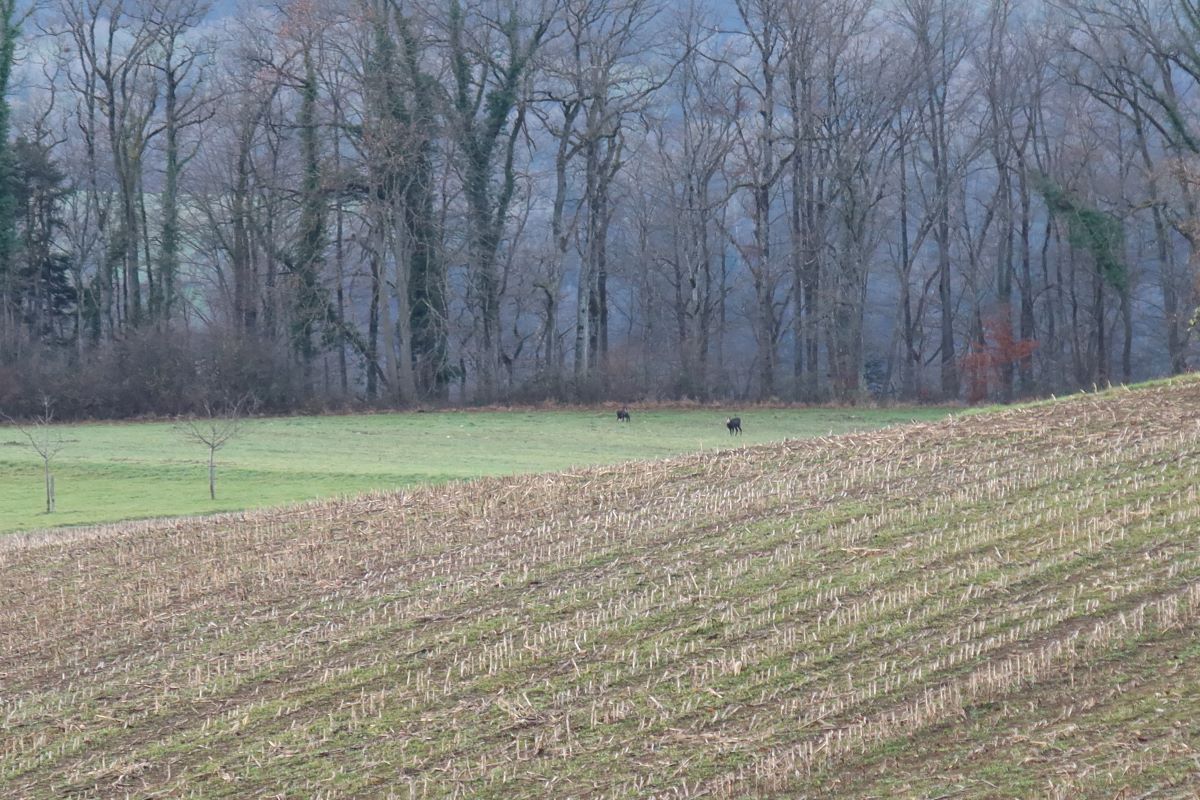
Two Gemsen near Kleinlützel


Moreover, in a few kilometres, centuries-old influences and domination from the Habsburg Empire, the Bishop of Basel, Solothurn, France, and, after 1871, successive German states are evident.

The Landskron (France)
The Felsplatte from World War I and World War II illustrates the proximity of the German-administered Sundgau (1871-1918 and 1940-1945) to France and Germany.
During the Thirty Years’ War (1618-1648), soldiers from Solothurn took up their positions here to observe the war in Sundgau. The viewpoint, then known as Plattenfels, gained fame throughout the country during World War I. The men’s hut still exists. The Felsplatte was brought back into use in 1939, equipped with guns, other weapons, and soldiers.

The rock (Fels)


And the Felsplatte overlooking the Sundgau
Fortunately for the Confederation, however, the Felsplatte did not become a Westerplatte (Gdansk).

The Westerplatte, commemoration of 1 September 1939


The Swiss Alpine Club
The Swiss Alpine Club (Schweizer Alpen Club, SAC/Club Alpin Suisse, CAS) organises regular hikes in this area and elsewhere in the country.
The SAC organises ski tours, mountain climbing, and other sports in the high mountains and the Alps, as well as hiking activities in other regions.

Not the top of the Mount Everest, but a hiking group of the SAC near Kleinlützel
(Source and further information: Gemeinde Kleinlützel)


Mariastein Monastery, in the background, the towers of Roche in Basel, the Schwarzwald and the Felsberg (Baden-Württemberg)


