The Customs Union between Switzerland and Liechtenstein
17 May 2023
Available in Dutch and German
This section contains an overview of the most relevant commemorations in Switzerland.
17 May 2023
Available in Dutch and German
12 April 2023
It is hard to imagine, but even the prestigious House of Habsburg has a beginning. The roots are in Aargau (Switzerland) and southern Alsace (France). The first and most important source is the Acta Murensia. This document is a chronological record of the foundation of the Muri monastery (canton of Lucerne) around 1160. The Counts of … Read more » “The Roots of Habsburg”
27 February 2023
Available in Dutch, French and German
8 February 2023
The first Winter Olympics in St Moritz (canton of Graubünden) began on 11 February 1928. Four hundred sixty-four athletes (including twenty-seven women) from 25 countries participated in six sports and 14 disciplines until 19 February, comprising speed skating, figure skating, ice hockey, bobsleigh and skeleton, skiing, ski jumping, cross-country skiing, and Nordic combination. Poster and … Read more » “The Olympic Village St. Moritz”
28 January 2023
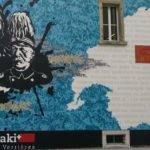
On 1 February 1871, the French general Justin Clinchard (1820-1881) and the Swiss general Hans Herzog (1819-1894) agreed in Les Verrières (canton of Neuchâtel) to allow the exhausted and defeated French army of 87,000 men and their horses and equipment to cross the border. The Bourbaki Panorama in Luzern, a European cultural monument, portrays this … Read more » “Bourbaki in Verrières and Lucerne”
24 January 2023
Charlemagne was the most powerful ruler of the Carolingian dynasty. He was born in 747 or 748, became emperor on Christmas Eve in 800 and died in Aachen on 28 January 814. In and around the church of St Peter in Samedan, so the story goes, more than 30 descendants of Charlemagne are buried, more … Read more » “Charlemagne and Samedan”
15 December 2022
As a centre of book printing, where Erasmus worked, and through its role as a mediator in religious policy, Basel became a place of refuge for religious dissidents and representatives of the Reformation in the mid-16th century. They engaged in a (multilingual) discussion among themselves and with Basel citizens. When the Spaniard Michael Servet (1511-1553) … Read more » “Castellio, Basel and Tolerance”
20 November 2022
The century ended in 1896. Revolutionary discoveries, inventions, art movements, and new political realities and parties created a new world. The Belle Epoque and the Fin de siècle also show the surge of cinema. The famous Cinématographe of the brothers and the anoscope are not the only relevant personalities (see also Chaplin’s World). François-Henri Lavanchy-Clarke … Read more » “Adieu Belle Époque in Tinguely”
21 October 2022
The House of Habsburg was one of Europe’s most influential royal houses. From 996 to 1815, the rulers of this dynasty had a decisive influence on culture and history. They shaped the future of Europe. Ententes and disputes, power struggles and territorial conquests, and times of war and peace divided peoples but reunited them and … Read more » “The Via Habsburg”
14 September 2022
The section’ Latest News’ contains the last sign of life and the last news of the Frank family to the outside world. Otto Frank (1889-1980) wrote on 4 July 1942 to his mother Alice Frank-Stern (1865-1953) and his sister Helene Frank (1893-1986) in Basel: “Seid doch in keinem Fall beunruhigt, wenn Ihr wenig von uns hört”. … Read more » “A Last Farewell by Otto Frank”