
Switzerland during the Second World War: As Neutral as It Was Involved
24 October 2026
Switzerland remained militarily neutral throughout the Second World War. Economically, however, the situation was far more complex. From 1943 onward, events along its southern border in particular revealed how difficult it was to maintain this balance.
Introduction
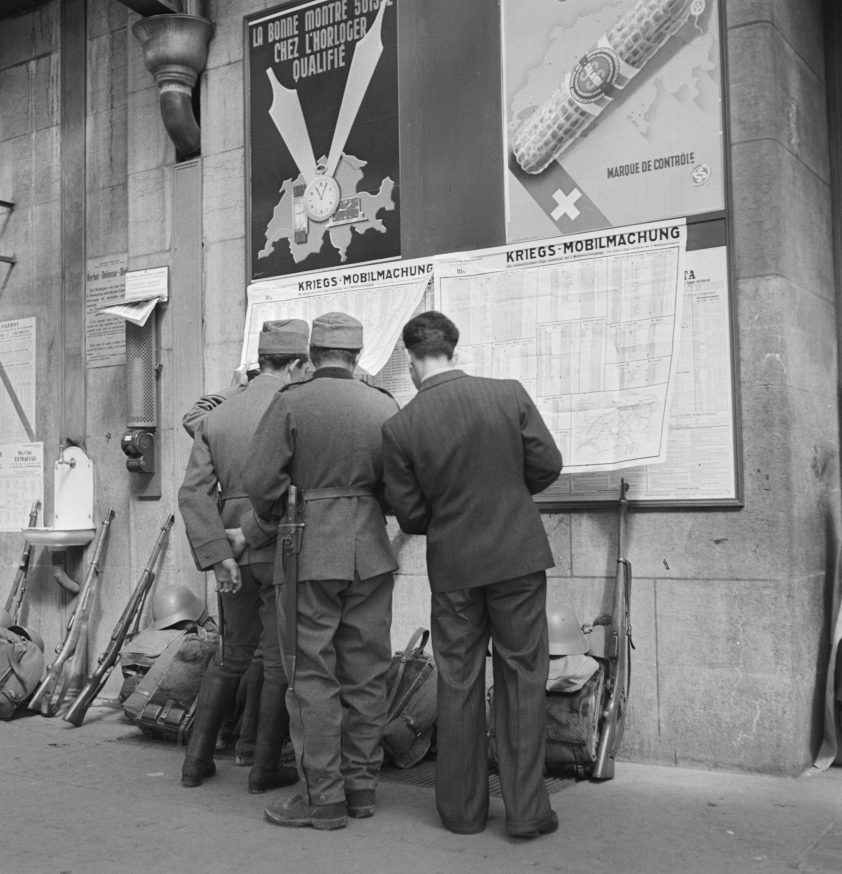
When the Second World War broke out on 1 September 1939, Switzerland ordered a general mobilisation. It called up approximately 430,000 soldiers and 200,000 members of various auxiliary services. After Germany invaded Denmark, Norway, Belgium, the Netherlands, and France, Switzerland ordered a second general mobilisation in May 1940. Switzerland prepared seriously for war while simultaneously trying to avoid it at all costs.
As a neutral country, the Swiss Confederation sought to stay out of the fighting as much as possible. Despite its pursuit of self-sufficiency, however, it was not self-reliant and remained dependent on economic relations with other countries. It needed German coal and iron, as well as Italian ports through which it imported goods from overseas.
Between 1940 and 1942, nearly 85% of Switzerland’s overseas imports passed through Italian ports, about 70% via Genoa. These were mainly essential foodstuffs, such as grain.
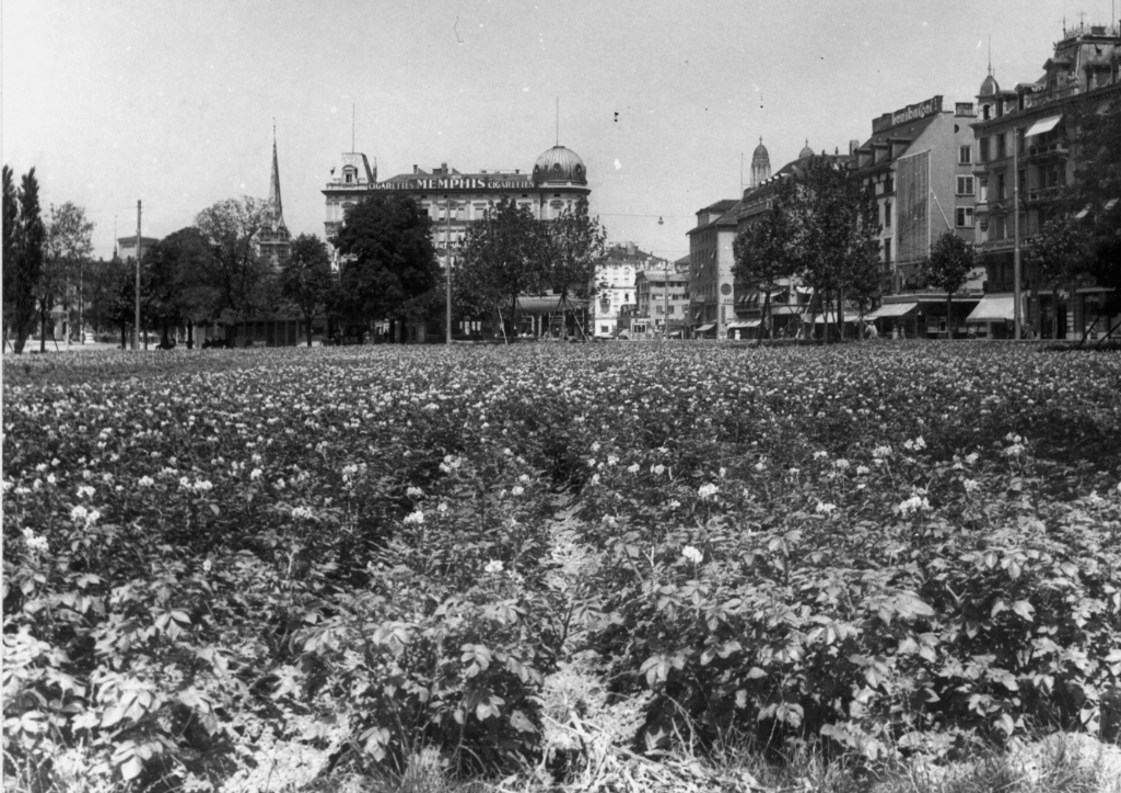
During the Second World War, Switzerland used every available plot of land to produce food. The Tonhalleplatz—now Sechseläutenplatz—in Zurich, in 1940. Baugeschichtliches Archiv Zürich.
Following France’s defeat in the summer of 1940, Switzerland’s situation changed radically. The country increasingly found itself in the grip of the aggressive Axis powers, Germany and Italy. When the previously unoccupied part of France was also occupied in November 1942, these powers completely encircled Switzerland.
A Fourth National Language as a Political Symbol
Unlike during the First World War, when sympathies for the different belligerents had partly divided Switzerland along linguistic lines, the country showed far greater unity by the late 1930s in the face of its totalitarian neighbours. The 1938 recognition of Romansh as the fourth national language underscored this determination to assert national identity: 91.6% of voters and every canton approved the decision. The country was to regard linguistic diversity not as a weakness, but as an integral part of Swiss identity.
Neither Germany’s annexation of German-speaking areas nor Italy’s claims to Ticino received much political support. In retrospect, Switzerland should have pursued different policies in certain areas, particularly regarding the rejection of Jewish refugees. Nevertheless, the country demonstrated its determination to preserve its neutrality and national independence above all.
From 1939 onward, the situation became increasingly precarious. After France fell, Switzerland had to take the possibility of a German or Italian invasion seriously. Subsequent events would show that Hitler did not hesitate to attack even former allies. After Italy concluded an armistice with the Allies, German troops occupied northern and central Italy in September 1943 and Hungary in March 1944.
The National Reduit Strategy
After France’s rapid capitulation in June 1940, Switzerland changed its strategy and shifted its defence to the difficult-to-access Alps. In the event of an attack, the army could continue fighting there under more favourable geographical conditions, while forcing the enemy to pay a high price to conquer the country. Known as the National Reduit, this strategy was based on the assessment that the Swiss army would struggle to defend the Swiss Plateau for any length of time against a mechanised Wehrmacht offensive.
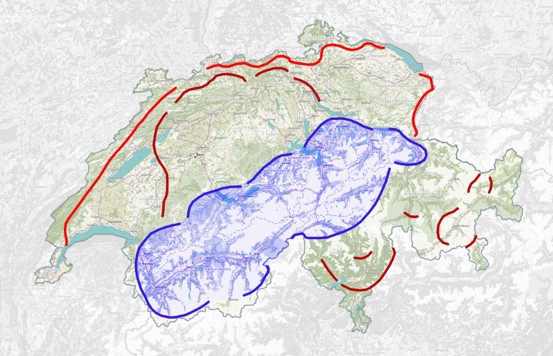
The Swiss National Redoubt strategy envisaged withdrawing most of the army into the blue zone to draw the enemy into prolonged fighting in the Alpine region. Picture: Wikimedia / Auge=mit.
This strategy nevertheless involved risks. Although the Swiss Plateau, essential to the country’s economy, was not to be surrendered without a fight, the Swiss did not intend to defend it at all costs against an invasion by a superior force. Consequently, a large proportion of the population and industry would remain outside the principal defensive zone. Moreover, under certain circumstances, the Swiss army could be cut off from its supply routes.
The military leadership knew retreating into the Reduit could be costly. The alternative, however, appeared even riskier: on open ground, the Swiss army risked being rapidly crushed by the Wehrmacht’s mechanised units. For the army leadership under General Henri Guisan (1874-1960), the Reduit strategy represented the least military risk. It also had a deterrent effect.
The strategy made clear to the Axis powers that the bulk of the Swiss army would continue fighting in the Alps and that an attack would destroy the strategic north–south transport links. The objective was to make occupying Switzerland militarily costly and economically unattractive.
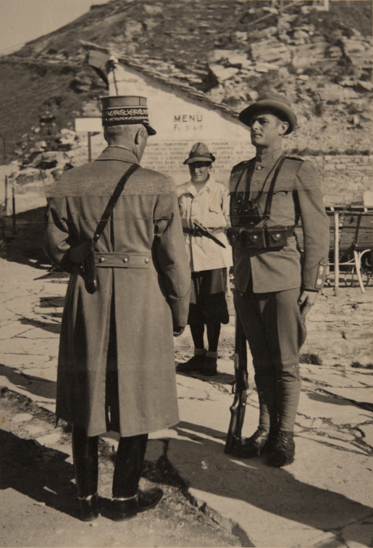
General Henri Guisan inspects the border post on Monte Generoso in the canton of Ticino in 1941. Source: Swiss National Museum.
Economic Considerations
Destroying the transport routes between Germany and Italy would have created serious logistical problems for the Axis powers. During the war, more than 40% of German coal deliveries to Italy passed through the Gotthard and Simplon tunnels.
Switzerland occupied a “grey area” defined by its neutrality, which shaped its economic policy. Militarily, the country remained outside the conflict and did not participate in the fighting, yet it simultaneously maintained economic relations with several belligerent countries. This policy was largely driven by Switzerland’s own economic and security interests. Maintaining an intact Swiss economy and operational transit routes was highly important to the Axis powers. The Reduit strategy therefore contributed to the deterrent effect of Swiss defence policy.
Germany and Italy were not Switzerland’s only economic partners. The Allies also bought Swiss products, including precision watchmaking components for aircraft instruments. They also used the Swiss financial sector. Both camps therefore attempted, each in its own way, to exploit the economic opportunities this neutral country offered. For Switzerland, it was not merely about preventing a military attack. The country depended heavily on imported raw materials and foodstuffs and needed to keep its export-oriented economy running.
The Turning Point of 1943
Until 1943, despite the constant threat, the war remained largely outside Switzerland’s borders. However, the collapse of the Berlin–Rome Axis suddenly changed the situation. Following the fall of Benito Mussolini on 25 July and the announcement of the armistice between Italy and the Allies on 8 September 1943, Germany responded immediately by occupying northern and central Italy.
Hundreds of thousands of Italian soldiers were disarmed. Approximately 700,000 were deported to the German Reich by the Germans as military internees. Many were subsequently subjected to forced labour. Around 100,000 men joined the newly established Fascist Republic of Salò. Almost as many went into hiding and joined the resistance. Over the following months, the partisan movement grew steadily stronger and repeatedly caused difficulties for the German occupying forces.
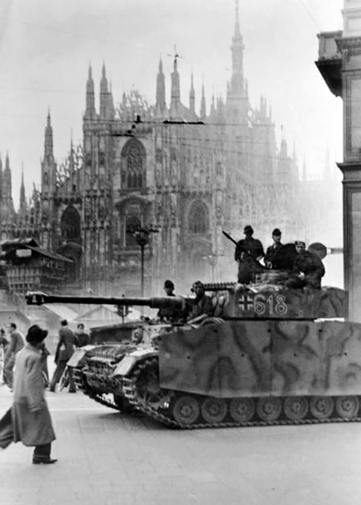
In September 1943, German troops occupied northern and central Italy. Tanks of the Leibstandarte SS Adolf Hitler appeared in Milan’s Piazza del Duomo. Source: Wikimedia / German Federal Archives.
Resistance fighters entrenched themselves in the Alpine regions near the Swiss border. With its many small valleys, dense forests, and remote mountain huts, the terrain suited guerrilla warfare: after launching rapid, brief surprise attacks, fighters immediately withdrew. The border’s proximity even let partisan units take refuge in Switzerland.
The Second World War Reaches Switzerland
The Second World War had now effectively reached Switzerland. It was no longer possible to look away. Between 1943 and 1945, a ruthless war raged along the country’s southern border between Italian partisans, the Fascists of Salò and the German occupying forces.
The situation deteriorated particularly in the Ossola region, which shares an approximately 150-kilometre border with the cantons of Valais and Ticino. The war did not remain confined to the other side of an otherwise clearly demarcated border. It had direct consequences for Switzerland’s southern border regions.
Here, neutrality was tested daily. Border guards, local politicians, civilians, and medical staff regularly had to decide how to apply the neutrality policy established in Bern in practice. Continued in part two.