Mariastein Abbey, the Gnadenkapelle and the Mirakelbild

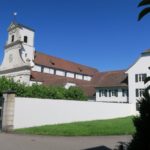
A Maria chapel, “im Stein” (in stone), was first documented in 1434. However, there was already another chapel, a rock chapel. The Chapel of Grace (Gnadenkapelle) remains a popular destination, attracting around 250,000 pilgrims annually. It is the heart and destination of the Mariastein pilgrimage. Over the centuries, the rocky cave has been converted into … Read more » “Mariastein Abbey, the Gnadenkapelle and the Mirakelbild”

Beinwil Abbey and the Valley

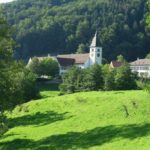
The first monks came from Hirsau (Black Forest, Baden-Württemberg) around 1100. Centuries before, there was a Celtic sanctuary on this hill. The first abbot was called Esso (he died in 1133). Hirsau was a monastery that introduced reforms, the Consuetudines Hirsaugienses. The Cluny Abbey was the inspiration. Beinwil was founded with financial support from local … Read more » “Beinwil Abbey and the Valley”

Pavillon Le Corbusier

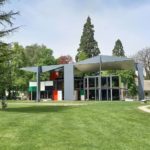
The Pavillon Le Corbusier on the shores of Lake Zurich is an architectural jewel. The idea for the building was initiated in 1961 by  Heidi Weber (1928). She encouraged Le Corbusier (1887-1966) to develop his museum and pavilion to express and explain his ideas and achievements. The Pavilion opened its doors on July 15th, 1967. … Read more » “Pavillon Le Corbusier”

Neuchâtel Castle

In a deed of 1011, Neuchâtel (Neuenburg, new castle, castellum novum) is described as a royal residence (of Rudolph III (970-1032), the last King of the Kingdom of Burgundy, 888-1032). The first castle was built in the 11th century on an easily defensible rock. As more houses were built around it in the 12th century, … Read more » “Neuchâtel Castle”

The Cathedral or Münster of Basel

The Cathedral of Basel (das Münster) is over a thousand years old. In 1019, after renovating its early medieval predecessor, the cathedral was consecrated in the presence of Emperor Heinrich II (973-1024) and his wife Kunigunde (975-1040). The copies Henry II (973-1024) and Kunigunde (975-1040), the originals, Museum Kleines Klingental Poster: Stadtgeschichte Basel St. Martin, … Read more » “The Cathedral or Münster of Basel”

The Cistercians and St. Urban Monastery

In the Middle Ages, 28 Cistercian monasteries were founded in Switzerland, eight for men and 20 for women. Today, only one men’s monastery (Hauterive, canton of Fribourg) and six women’s monasteries remain (Frauenthal, canton of Zug; La Maigrauge and La Fillle-Dieu, canton of Fribourg; Magdenau and Wurmsbach, canton of St Gallen, and Eschenbach, canton of … Read more » “The Cistercians and St. Urban Monastery”

Donatyre and Romanesque Art in Switzerland

From the 11th to the 14th centuries, the area of present-day Switzerland was not a political unity. Several dynasties (a.o. Habsburg, Kyburg, Zähringen, Savoye, Swaben), small local rulers, the German emperor and powerful abbots and bishops (Geneva, Sion, Lausanne, Chur, Basel, and Constance) ruled over smaller or larger areas. These areas lay on the borders … Read more » “Donatyre and Romanesque Art in Switzerland”

The Johanniter Order and their Chapel in Rheinfelden

25 November saw the publication of the new edition of the Swiss Art Guide series (Schweizerische Kunstführer), a publication of the Gesellschaft für Schweizerische Kunstgeschichte (GSK)/Sociéte d’histoire de l’art en Suisse (SHAS). The beautifully illustrated edition highlights the Johanniter Chapel of the Johanniter Order in Rheinfelden (canton Aargau). The Johanniter Order was founded in the … Read more » “The Johanniter Order and their Chapel in Rheinfelden”

Monte Verità near Ascona

Canton Tessin has long been (and still is) a haven for political refugees, artists and the avant-garde. Locarno, Lugano and Ascona were sought-after towns. Houses, islands and even hills and mountains got new destinations after 1848. Alfredo Pioda (1848-1909), Franz Hartmann (1838-1912), and Countess Constance Wachtmeister (1838-1910) founded a theosophical institution on Monte Verità near … Read more » “Monte Verità near Ascona”

Wartenfels Castle and the Bishop who did not spend the night

Avaliable in German, French and Dutch