
Rembrandt in Basel
30 December 2020
Rembrandt van Rijn (1606-1669) never visited Basel, unlike Erasmus of Rotterdam (1466-1536). Erasmus is even buried in the cathedral (Münster) of Basel (1536). However, at that time, Basel was no longer an episcopal city, and the cathedral had become a reformed church since the Reformation in 1529.
More than 350 years after the death of Rembrandt, the Catholic humanist meets the Protestant painter. The art museum, situated at the foot of the cathedral and near Erasmus’s last residence, focuses on Rembrandt and his artistic connections to the Orient.
Although Rembrandt never visited the Orient, oriental objects were often an essential motif in his art. The United East India Company (Vereenigde Oost-Indische Compagnie, VOC) was founded just before his birth (1602).
The young self-confident Protestant Republic ruled the seas, made possible by the Twelve Year Truce (1609-1621) with the Spanish Habsburgs.
The Orient was a broad concept at the time. It included all territories east of Vienna, such as Hungary, the Balkans, Persia, the Ottoman Empire, China, and North Africa.
The Ottoman Empire was the formidable (Islamic) opponent of the Catholic Habsburgs and thus an ally of the Protestant Republic (“a Turk rather than a pope”).
The exhibition (Rembrandt’s Orient. West Meets East in Dutch Art of the Seventeenth Century, Rembrandts Orient. Westöstliche Begegnung in der niederländischen Kunst des 17. Jahrhunderts) is not an exhibition about Rembrandt. It focuses on his art, featuring Oriental images. It places the use of Oriental motifs within the context of his time and contemporary artists.
In addition to top paintings and engravings by the Master himself, including a painting from the collection of the Earl of Derby in Liverpool (hundred years not shown in public), there are many works by contemporaries, including paintings by his teacher Pieter Lastman (1583-1633), still lifes, miniatures, engravings, documents, city views and an Asia map by Willem Jansz Blaeu (1571-1638).
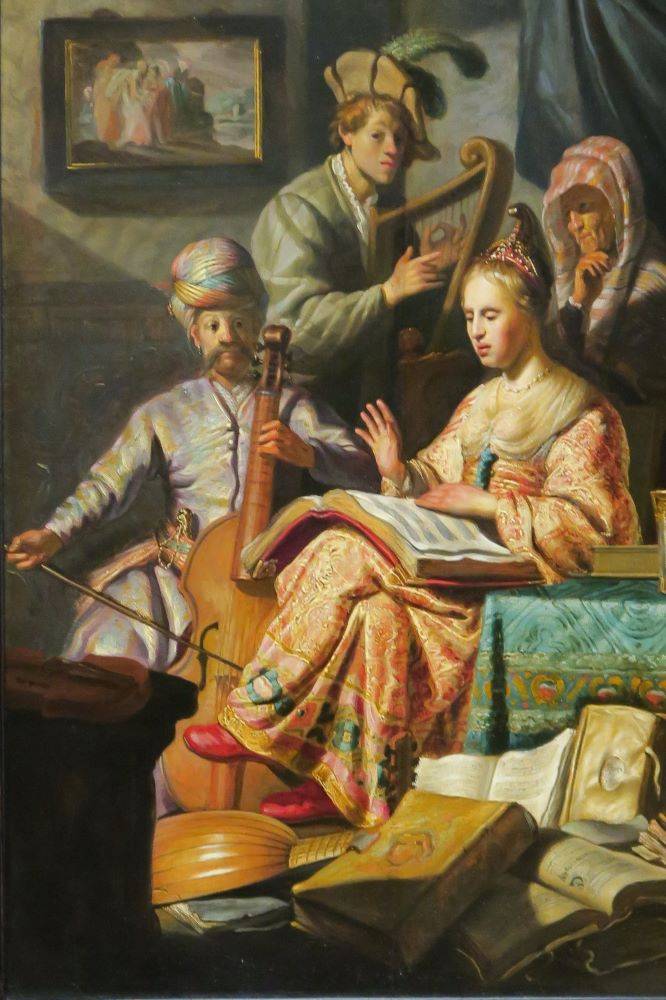
The exhibition begins with a militia piece and the black and white clothing of the Calvinist rulers (by Bartholomeus van der Helst (1613-1670). The painting also shows an oriental tapestry. Rembrandt was aware of the interest in the Orient, and as a starting point, he made a change in 1626.
He gave a wrong interpretation, however: a (Calvinistic) moralistic image in an oriental setting (music, turban, oriental motifs, scantily clad lady. It could only mean one thing.
He missed the point as a beginner. Oriental objects could not be used in a moralising manner, but only as a confirmation of the status of the merchant, politician or explorer.
The show presents extraordinary objects and stories, such as the beginnings of Oriental studies and scholarly interest, the first Dutch translation of the Koran, and a collection of miniatures with Oriental motifs from the Millionenzimmer, collected by Empress Maria Theresa (1717-1780) of the Court in Schönbrunn near Vienna.
The portrayal of sultans (and thus the elite of the Republic) was a delicate issue, even then, as witnessed by Samuel van Hoogstraaten (1627-1678) in his work on the art of painting (Inleyding tot de hooge schoole der schildererkonst; anders de zichtbaere werelt (1678). At the exhibition, one can read:
“Do you wish to portray the Turkish Sultan in all his magnificence? Then paint him in white satin or silver cloth mixed with green, and patterned with large flowers. Set the lofty turban with its painted feathers on his head” (Lust u den Turkschen Sultan in zijn pracht te verbeelden? zoo schilder hem in’t wit Satijn of zilver laken met groen vermengt, en met groote bloemen doorwrocht. Stel hem den hoogen Tulbant met geschilderde veeren op’t hooft).
It remains topical, although the sultan and the Oriental world have lost their status.
(further information: www.kunstmuseumbasel.ch).